


Working at a computer, with papers in the office, assembling small parts behind a conveyor belt for a long time - all this tires the eyes and sooner or later can lead to myopia.However, simple but regular exercise can not only be an excellent preventive measure against vision loss, but also prevent diseases such as cataracts and glaucoma.
Who invented eye exercises?
Already in ancient times, the problems of restoring vision worried the minds of great scientists, priests and thinkers.Gradually, through trial and error, a certain system of exercises was created, echoes of which can be found in the works of Bates and other authors.Many experts criticize these exercise systems, but others consider them completely reasonable and acceptable.
Many ophthalmologists were also involved in the development of eye exercises, in particular a professor who worked for many years in management positions at the Research Institute of Eye Diseases.Under his direction, a series of exercises were also developed aimed at improving blood circulation, normalizing intraocular pressure and increasing visual acuity.
Currently, in addition to the usual eye exercises that a person can perform, there are special computer programs and hardware methods for vision correction.
Exercises to improve vision according to the teacher's method.
General strengthening exercises.Although many people believe that if you are nearsighted, just doing a few eye exercises is enough, it turns out that a sedentary lifestyle and poor physical fitness alone contribute to the progression of myopia.The opposite is also true: daily exercise and moderate physical work are excellent means of preventing vision loss.
In the 80s of the last century, it was discovered that the following types of physical activity help strengthen the ciliary muscle of the eye and improve blood circulation, if the pulse is in the range of 100 to 140 beats per minute:
- in a hurry;
- walking;
- skiing;
- swim.
However, when performing the same exercises with a heart rate of 180 beats per minute, as well as jumping rope, gymnastics and acrobatics, a progression of myopia is observed due to the deterioration of accommodation and blood circulation of the eye.
How can you determine your heart rate to get the most visual benefits from running or walking?Of course, you can simply measure with special instruments or count the number of heartbeats for 10 seconds and then multiply it by 6. If this seems difficult to you, you can use the following method: Physical activity is considered moderate if a person is able to speak in short, abrupt phrases during sports.If the load is too heavy, which will be harmful to the eyes, breathing is enough to pronounce only short words, for example, "yes", "no", "I don't know", etc.
special exercises
They are divided into three groups: to improve blood circulation and accommodation, as well as to strengthen the eye muscles.
Exercises to improve blood circulation and normalize intraocular pressure.
The objective of these exercises is that you should periodically do with your eyes:
- flash frequently (for example, for a quarter of a minute), then pause briefly to rest and repeat again 4 times;
- close your eyes for 5 seconds (do it 8 times);
- Gently massage eyes through closed eyelids for 1 minute and then repeat by pressing them 3-4 times with three fingers for one second.
Exercises to strengthen eye muscles.
The muscles of the eyeball are strengthened and maintain their shape well if we gently move our gaze without turning our head:
- vertically up-down, bottom-up;
- along one, then the second diagonal in the direction from top to bottom;
- horizontally from left to right;
- rotate clockwise and vice versa.
It is advisable to perform almost all the exercises in this block up to 10 times.
Exercises for visual acuity.
The exercises in this group are based on moving your gaze from near to far and back (while fixating your gaze on each position for 3-5 seconds).Could be:
- bring the index finger at the level of the nose towards the face (so that its image bends) and remove it with the arm extended;
- looking at a colored mark at eye level on the window and looking at a distant object located along our line of vision for 5 to 7 minutes daily.
Useful and fun exercises for children.
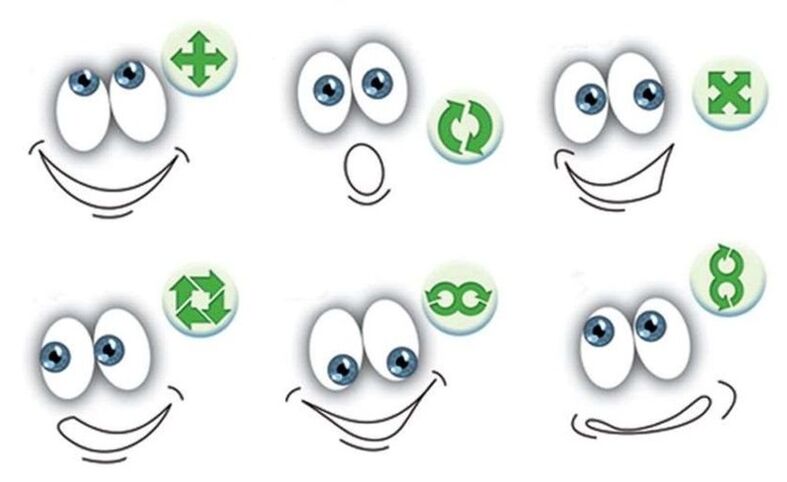
Not all children can do these exercises several times a day.And this is where games that train the accommodation of the eyes and strengthen their muscles come to the rescue.It is important to exclude those games in which there is a high probability of blows in the face, collisions, strong efforts or efforts.
The following activities can largely replace "boring" exercises for children and help improve vision:
- short and fast run (patch, catch up);
- catch and pass the ball;
- throw a ball (a small bag of sand) against a wall or a target on the ground.
During school hours, approximately halfway through the lesson, it is advisable to blink rapidly for 30 seconds and then sit for 1 minute with your eyes closed, while leaning back in your chair.